
Contested Divorce Attorney in Greensboro, NC
At The Spagnola Law Firm, we start from the belief that everyone who faces the court system should have experienced legal counsel who represents their best interests.
A Greensboro contested divorce attorney at The Spagnola Law Firm can be your guide and partner through a divorce proceeding. When you are involved in a contested divorce, it can feel like everyone is against you. You should not feel that way about your attorney. With The Spagnola Law Firm, you never have to.
When divorcing spouses cannot agree on important family issues, working with a dedicated Greensboro contested divorce lawyer at the Spagnola Law Firm is vital. Facing a divorce without a skilled legal advocate leaves your parental rights and financial future vulnerable. We can help you protect what matters most during this difficult time.
At The Spagnola Law Firm, we listen attentively, examine your legal options, and prepare a legal strategy customized to your goals. Call us today at 336-704-2921 to schedule your initial legal consultation.
What is a Contested Divorce in North Carolina?
A divorce is contested in North Carolina when the parties cannot agree on one or more key legal issues. Some spouses may resolve these questions cooperatively with a property settlement agreement, but conflicts over property division, child custody and support, or alimony frequently require court intervention.
To file for divorce in North Carolina, at least one spouse must have resided in North Carolina for at least 6 months. The spouses must reside in separate homes for at least 1 year and intend to remain separate. Living in separate bedrooms in the same house does not fulfill the separate residence requirement.
In North Carolina, a contested divorce involves gathering evidence, filing legal documents, and attending divorce proceedings. When private divorce negotiations do not move the process forward, a district court judge resolves the disputed issues. The Spagnola Law Firm can guide you through every phase of this process while protecting your rights.
The Contested Divorce Process in Guilford County
You may wonder how long a contested divorce will take in North Carolina. Each case is unique, but some general factors apply to most situations.
The usual rule of thumb is that the longer a couple has been married, the longer a contested divorce will typically take. There are likely more contested issues because there was more time for disagreements to develop during the marriage.
Divorce proceedings in Greensboro involve specific procedural steps and administrative guidelines. Family law cases in Guilford County are heard at the Guilford County Courthouse (201 South Eugene Street in Greensboro) or the High Point Courthouse at 505 East Green Drive in High Point.
Complaint and Summons Filing
A contested divorce begins in Guilford County when one spouse submits a formal divorce complaint and summons to the Clerk of the Superior Court. The complaint sets forth the party’s claims regarding property division, child custody and support, and/or spousal support.
Service and Response
The filing party must serve the court documents on the other spouse by certified mail, sheriff’s delivery, or an authorized process server. The receiving spouse has 30 days to submit a written answer and present counterclaims.
If a spouse intentionally becomes difficult to locate, that does not mean the divorce will be delayed indefinitely. You may also serve divorce papers through a delivery service or certified mail. If these are unsuccessful, the court may authorize the publication of a notice in a local newspaper.
Financial Disclosures and Discovery
Both divorce lawyers gather relevant evidence through formal discovery. This stage involves exchanging financial documents, tax returns, wage statements, property deeds, and debt records. Complete transparency is mandatory for evaluating marital property and determining support obligations.
Mandatory Court-Ordered Mediation
North Carolina requires mandatory mediation before trial in most contested divorces. If mediation results in an agreement, attorneys draft a binding agreement or a consent order. If mediation fails, the unresolved issues proceed to trial.
District Court Trial
When disputes cannot be settled voluntarily, they are referred to a district court judge. In a North Carolina divorce proceeding, both sides may offer evidence, call witnesses, and make legal arguments to the court.
Key Issues Resolved in Contested Divorce Cases
Contested divorces usually involve multiple issues. The Spagnola Law Firm handles every dimension of your contested divorce case and protects your rights across all contested areas.
Equitable Distribution of Marital Property
Splitting a couple’s assets and debts in a contested divorce proceeding requires a careful evaluation of the couple’s finances. North Carolina follows the equitable distribution rule. The court divides assets into three distinct legal categories:
- Separate Property: Assets acquired by one spouse before marriage, or received during marriage through gift or inheritance from a third party.
- Marital Property: All real estate, personal property, bank accounts, business assets, and retirement benefits acquired by either spouse during the marriage but before the separation date.
- Divisible Property: Post-separation changes in the value of marital assets, passive income received from marital property, and passive changes in marital debt.
The more assets and property a married couple owns, the longer a divorce may take. Property distribution can be contentious, particularly when a property item cannot be divided equally.
North Carolina presumes a 50/50 division of marital property and assets is equitable and just, but a court may order an unequal division after considering each spouse’s income, health, the duration of the marriage, and any custody obligations.
Child Custody and Best Interests of the Child
Determining where children live and how decisions about them are made is often the most emotionally charged aspect of a contested divorce. North Carolina courts decide legal and physical custody based strictly on the best interests of the child. Neither parent is presumed to be a better parent based on gender.
The parenting schedule informs and determines a child’s physical custody. Legal custody is a parent’s authority to make choices regarding a child’s healthcare, education, social activities, and best interests. The courts consider a parent’s stability, living arrangements, and any history of domestic abuse.
Child Support Calculations
Parents have a mutual legal responsibility to financially support their minor children. Child support amounts are calculated using the North Carolina child support guidelines. The verification of incomes ensures child support orders are fair and reflect true earnings.
The guidelines account for the parents’ incomes, ongoing child or spousal support obligations, health insurance costs, work-related childcare expenses, and the number of nights a child spends with each parent.
Post-Separation Support and Alimony
Spousal support disputes can arise when one spouse has financial needs, and the other can pay. In North Carolina, spousal support is either post-separation support (temporary aid) or alimony (longer-term support).
Before issuing a spousal support order, North Carolina courts determine whether one partner has been financially supporting the other. Courts then consider the couple’s standard of living, the length of their marriage, the spouses’ earning capacities, and any marital misconduct before the separation date.
Serving Greensboro and the Surrounding Triad Area
We represent clients in Guilford County, including High Point and Greensboro, and our considerable experience in other jurisdictions ensures that your case is handled with attention and care. We also represent clients in Randolph County, including Asheboro and Randleman, as well as Alamance, Davidson, Forsyth, and Rockingham Counties.
Strategic Advocacy for Contested Divorce Cases
Prevailing in a contested North Carolina divorce requires a precise strategy and effective representation. The Spagnola Law Firm assists our clients by identifying their core legal goals, gathering the pertinent evidence, scrutinizing complex asset structures, and defeating the opposing party’s unreasonable demands.
If you are involved in a contested divorce, you must have aggressive, vigorous courtroom representation. We work to develop creative solutions during negotiations, but we remain fully prepared to advocate for your interests before a judge when an agreement cannot be reached.
Let The Spagnola Law Firm Represent You
Since 2008, Sam Spagnola has been a board-certified divorce and family law attorney. For more than two decades, The Spagnola Law Firm has focused on family law. We stay up-to-date with current legal developments without losing sight of what’s most important: your case.
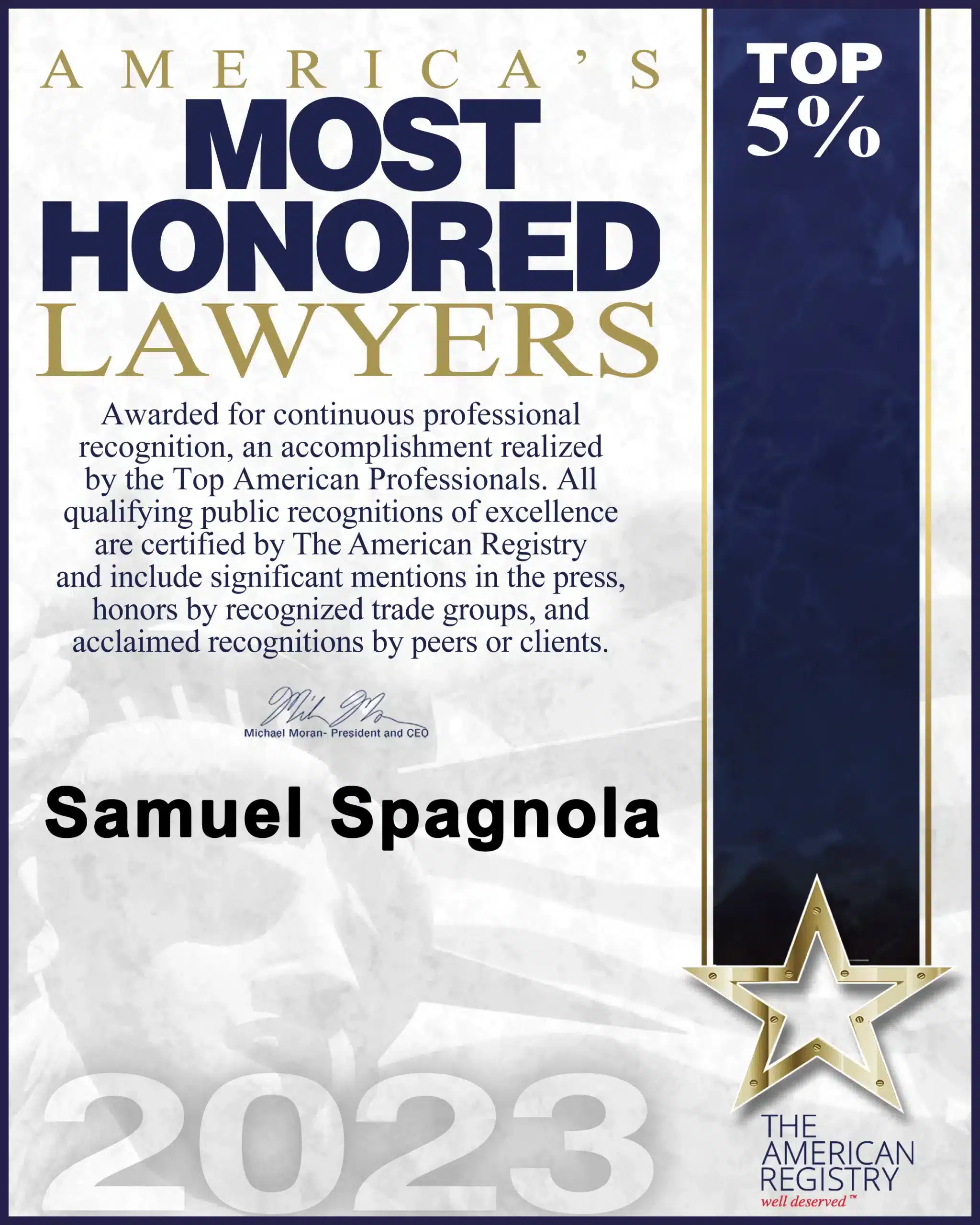
Over the years, attorney Sam Spagnola has handled complicated property division cases, hotly contested custody disputes, and other difficult situations. The Spagnola Law Firm has received extraordinarily positive client reviews, and attorney Sam Spagnola has also been recognized positively by his peers.
Take the first step toward securing your future today. Call The Spagnola Law Firm at 336-704-2921 to schedule your first legal consultation.
CLIENT REVIEWS
What Our Clients Say



RECOGNIZED & AWARDED






Take Your Next Step Today
Ready to talk? Call us today at 336-704-2921 or send a message and our team will reach out to schedule your consultation.